
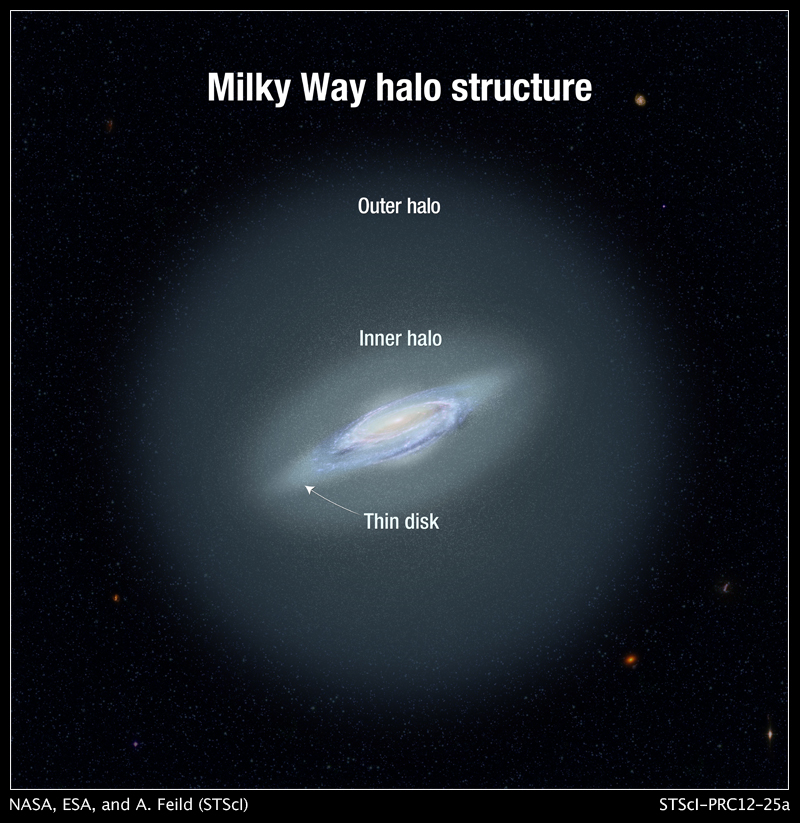
(Image Credit: NASA/ESA/STScI)
The Milky Way’s metal-poor stellar halo is mostly built up from the ancient accretion of dwarf galaxies. Studying the chemical abundances of these stars provides insights to the Milky Way’s accretion history, the formation and evolution of dwarf galaxies, first galaxies during the epoch of reionization, and early nucleosynthesis. Mapping the kinematics of these stars can recover the signature of individual accretion events and constrain the shape of the gravitational potential of the Milky Way, including the dark matter halo and the interaction with the Large Magellanic Cloud.
Instead of a random sample of halo stars, SDSS-V is targeting three extreme regions of the halo parameter space:
- the distant halo, targeting tracers that reach to 30 kpc and beyond,
- the metal-poor halo, selecting red giant stars likely to have [Fe/H] < -2, and
- the local halo, selecting stars within 2 kpc and with tangential
velocities > 150 km/s, which mostly consist of low-mass (K/M)
main-sequence stars from the Milky Way inner halo.
Starting in DR20 (targetdb version 1.0 and later), the halo program was converted from a spare fiber program to a “shell” carton: it does not control targeting, but halo targets are observed with higher priority than before. DR20 thus represents a substantial increase in the number of halo targets. Details about the distant and metal-poor programs are described in Chandra et al. (2026) . A description of the Local Halo is in the DR20 paper.
Because the halo stars are chosen to be rare outliers, it is highly recommended to use the Value Added Catalogs to study halo stars. We recommend using the MINESweeper VAC for the distant and metal-poor halo sub-programs. Filtering the BOSS spAll file for Gaia sources with the kinematic cut or the appropriate cartons with sdss_semaphore is the best way to get the local halo sample. There are no great spectroscopic stellar parameter catalogs for the local halo stars (the dominant population is metal-poor K and M dwarfs), but the BOSS-CLAM VAC provides a reasonable start.
Cartons
Distant Halo Cartons
Distant Halo: blue horizontal branch stars
manual_mwm_halo_distant_bhb_boss
manual_mwm_halo_distant_bhb_boss_single
manual_mwm_halo_distant_bhb_boss_triple
Distant Halo: K giants, distance > 30 kpc candidates
manual_mwm_halo_distant_kgiant_far_boss
manual_mwm_halo_distant_kgiant_far_boss_single
manual_mwm_halo_distant_kgiant_far_boss_triple
Distant Halo: K giants, distance > 10 kpc candidates
manual_mwm_halo_distant_kgiant_near_boss
manual_mwm_halo_distant_kgiant_near_boss_single
manual_mwm_halo_distant_kgiant_near_boss_triple
Distant Halo: Gaia DR3 RR Lyrae
mwm_halo_distant_rrl_boss
mwm_halo_distant_rrl_boss_single
mwm_halo_distant_rrl_boss_triple
Metal-Poor Halo Cartons
“Metal Poor”: medium priority targets from modified Best & Brightest WISE selection
manual_mwm_halo_mp_wise_apogee
manual_mwm_halo_mp_wise_apogee_single
manual_mwm_halo_mp_wise_apogee_triple
manual_mwm_halo_mp_wise_boss
manual_mwm_halo_mp_wise_boss_single
manual_mwm_halo_mp_wise_boss_triple
“Very Metal Poor”: high priority targets from modified Best & Brightest WISE selection
manual_mwm_halo_vmp_wise_apogee
manual_mwm_halo_vmp_wise_apogee_single
manual_mwm_halo_vmp_wise_apogee_triple
manual_mwm_halo_vmp_wise_boss
manual_mwm_halo_vmp_wise_boss_single
manual_mwm_halo_vmp_wise_boss_triple
“Metal Poor”: -2 < [Fe/H] XP < -1.5, medium priority
mwm_halo_mp_xp_apogee
mwm_halo_mp_xp_apogee_single
mwm_halo_mp_xp_apogee_triple
mwm_halo_mp_xp_boss
mwm_halo_mp_xp_boss_single
mwm_halo_mp_xp_boss_triple
“Not Metal Poor”: -1.5 < [Fe/H] XP < -1.0, low priority filler carton
mwm_halo_nmp_xp_apogee
mwm_halo_nmp_xp_apogee_single
mwm_halo_nmp_xp_apogee_triple
mwm_halo_nmp_xp_boss
mwm_halo_nmp_xp_boss_single
mwm_halo_nmp_xp_boss_triple
“Very Metal Poor” [Fe/H] XP < -2.0, high priority carton
mwm_halo_vmp_xp_apogee
mwm_halo_vmp_xp_apogee_single
mwm_halo_vmp_xp_apogee_triple
mwm_halo_vmp_xp_boss
mwm_halo_vmp_xp_boss_single
mwm_halo_vmp_xp_boss_triple
Local Halo Cartons
Vtan > 200 km/s
mwm_halo_local_high_apogee
mwm_halo_local_high_apogee_single
mwm_halo_local_high_apogee_triple
mwm_halo_local_high_boss
mwm_halo_local_high_boss_single
mwm_halo_local_high_boss_triple
Vtan > 150 km/s
mwm_halo_local_low_apogee
mwm_halo_local_low_apogee_single
mwm_halo_local_low_apogee_triple
mwm_halo_local_low_boss
mwm_halo_local_low_boss_single
mwm_halo_local_low_boss_triple
mwm_halo_bb
This is a plate era “filler” carton targeting all of the “Best and Brightest” halo targets identified by Schlaufman and Casey (2014). The program associated with this carton is mwm_filler, but the alternate program associated with this carton is halo to properly link these stars to this program.
mwm_halo_bb_boss
This is the FPS-era version of the mwm_halo_bb carton, but unlike its predecessor, the program associated with this carton is mwm_halo.
mwm_halo_sm
This is a plate era “filler” carton targeting all metal-poor ([Feh/H] < -1.7) stars in Casagrande et al. (2019). Like mwm_halo_bb, the program associated with this carton is mwm_filler, but the alternate program associated with this carton is halo.
mwm_halo_sm_boss
This is the FPS-era version of the mwm_halo_sm carton, but unlike its predecessor, the program associated with this carton is mwm_halo.
Associated open fiber cartons
In DR19, a pilot for halo star selection was implemented as part of open fiber programs. The three regions were targeted as:
-
Distant Halo
- openfibertargets_nov2020_6a
- openfibertargets_nov2020_28a
- openfibertargets_nov2020_28b
- openfibertargets_nov2020_28c
-
Metal-poor halo
- openfibertargets_nov2020_5
- openfibertargets_nov2020_6b
- openfibertargets_nov2020_6c
- openfibertargets_nov2020_35a
- openfibertargets_nov2020_35b
- openfibertargets_nov2020_35c
-
Local Halo
- openfibertargets_nov2020_25
Several of these open fiber halo cartons are moved to higher priority starting in DR20, and full selection functions will be released at that time.
Cadences
During plate operations, mwm_halo_bb and mwm_halo_sm targets could be observed with BOSS at low priority on any plate except those with the RM cadence.
In the FPS era, mwm_halo_bb_boss and mwm_halo_sm_boss targets were taken with the low-resolution optical BOSS spectrograph with the bright_1x1 cadence.
For all other cartons, each halo carton was provided three different times at different priorities for one (*_boss_single), two (*_boss), and three (*_boss_triple) exposures (and the same for APOGEE) for maximum flexibility. Three exposures corresponds to the same target being visited 3 times for a single SPIDERS visit, which is why we stopped there. The targets are identical for each cadence, and it is recommended to select on the *_single cartons.