
The SDSS-V Black Hole Mapper (BHM) project emphasizes the study of quasars and other active galactic nuclei (AGN). These are among the Universe’s most luminous objects, are powered by accretion onto supermassive black holes (SMBHs), and are co-evolving via feedback with the host galaxies in which they reside. BHM exploits – with order(s) of magnitude advances – two hallmark characteristics of quasars: their marked variability on a range of timescales, and prodigious luminosity extending to X-rays. The BHM project includes the following major core components:
- Repeat time-domain optical (BOSS) spectra of ~104.5 known quasars over a broad range of timespans from days to decades, sampling changes on light-travel, dynamical, and thermal timescales, in order to: measure BH masses; study broad line region (BLR) dynamics; capture and discover events, such as those in changing look quasars; and understand the astrophysics of quasar accretion and outflows. These time-domain approaches probe spatially unresolved size scales, for large samples of quasars.
- Optical (BOSS) follow-up spectroscopy of ~105.5 eROSITA – as well as ~104.5 Chandra – X-ray source counterparts, with BHM spectra providing counterpart identifications and redshifts, to study the demographics, evolution, and astrophysics of X-ray sources. These counterparts are mainly quasars/AGN , but also include X-ray emitting galaxy clusters and stars.
DR20 includes the release of ~1 million BOSS spectra for ~0.5 million distinct BHM objects (a 3-4 times expansion vs. DR19), collected from both the Sloan Foundation 2.5m Telescope at APO in New Mexico (USA), and from the du Pont 2.5m Telescope at the Las Campanas Observatories (LCO; in Chile). The released data extend across nearly the full suite of main BHM programs, and, new for DR20, emphasize both northern/equatorial fields (from APO) and also the first public release of BHM data in more-southern fields (from LCO).
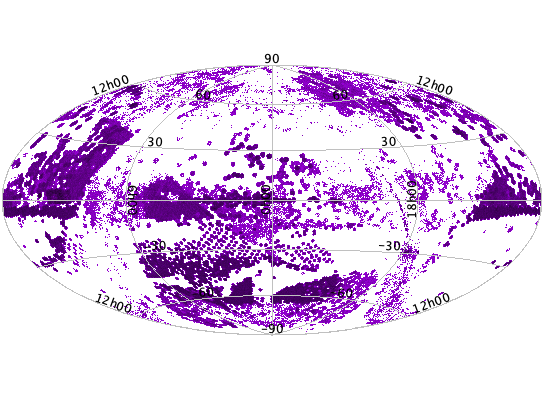
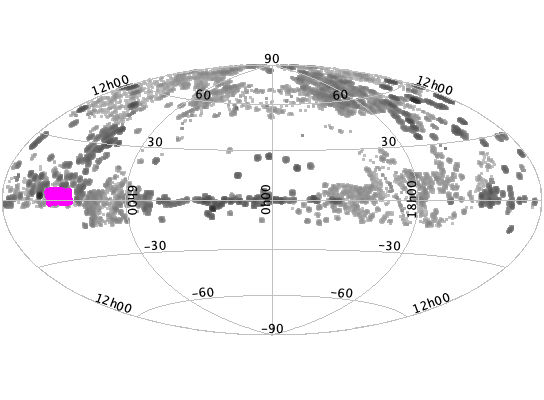
Summary of BHM Science Programs
The BHM Science Programs page provides further details about the science goals and target selection algorithms for: AQMES (All-Quasar Multi-Epoch Spectroscopy) and RM (Reverberation Mapping) which are the BHM core repeat time-domain spectroscopy science programs; SPIDERS (SPectroscopic IDentfication of ERosita Sources) which is the core BHM program of eROSITA X-ray source counterpart spectroscopic follow-up; CSC (Chandra Source Catalog) X-ray counterpart follow-up; and other related Ancillary science programs. Additional BHM Science Background information may be found below.
Summary of BHM Instrumentation/Data
BHM primarily makes use of the fiber-fed BOSS optical spectrographs, with the FPS robotically positioned fiber system from both the Sloan Foundation 2.5m Telescope at Apache Point Observatory (APO) and the Irénée du Pont Telescope at Las Campanas Observatory (LCO). The combination of these facilities allows SDSS-V to observe anywhere on the sky. BOSS optical data are reduced with the BOSS pipeline. See the BHM Getting Started and BHM Data pages and links therein for some further hints on beginning to work with BHM data (and the BHM Caveats page for some things to keep in mind).
BHM Infrastructure and Science Organization
BHM Program Head: Scott Anderson (Univ. of Wash.),
BHM Survey Scientists: Andrea Merloni (MPE) and Yue Shen (Univ. of Illinois)
BOSS pipeline: Sean Morrison (Univ. of Illinois) and Hector Ibarra-Medel (UNAM)
BHM targeting and survey strategy: Tom Dwelly (MPE) and Jon Trump (Univ. of Conn).
Commissioning scientist: Joe Burchett (NMSU)
Current BHM Scientific Working Groups (and their co-chairs)
Quasar Physics: Mike Eracleous (Penn State Univ.) and Benny Trakhtenbrot (Tel Aviv Univ.)
Reverberation Mapping: Kate Grier (Univ. of Wisc.) and Keith Horne (Univ. of St Andrews)
AGN Demographics: Johannes Buchner (MPE) and Amy Rankine (Edinburgh)
X-ray Clusters of Galaxies: Joe Burchett (NMSU); and previously, J. Comparat (now, Grenoble)
Further BHM Science Background
Quasars are among the most luminous objects in the Universe, powered by accretion onto supermassive black holes (SMBHs), and they trace the growth of SMBHs across cosmic distance and time. The tight correlation between the mass of the central SMBH and the properties of its host galaxy demonstrate a clear connection between the formation of the galaxy’s stellar component and the growth of its central SMBH.
In order to study the astrophysics and cosmic history of accreting SMBHs, several parameters are especially important, including BH mass, bolometric luminosity, and radiative efficiency. Radiative efficiency (the fractional energy release per accreted mass) can be obtained from models of the continuum spectral energy distribution (SED) and variability, and most reliably where the BH mass is well determined. In turn, observational tests of BH theory and cosmic growth history seek accurate measures of BH mass, multi-wavelength SEDs (with redshifts needed to estimate luminosity), and variability characteristics. The Black Hole Mapper program in SDSS-V is providing such measures accurately for unprecedentedly large samples, exploiting two hallmark characteristics of quasars, as accreting SMBHs: their marked spectral variability across a range of timescales, and their prodigious luminosity extending even up to X-rays.
Most quasars show variability (typically ~10%) that encodes information about the structure and dynamics of emitting regions, probing the underlying physics of accretion and feedback processes in active SMBHs. Most quasars also show energetic X-ray emission, at once allowing us to peer deeply into central engines while also providing an (obscuration-)unbiased census of actively accreting SMBHs and their cosmic evolution. It is in the innermost parts of the accretion flow (hot X-ray corona, accretion disk, BLR, etc.), all within the gravitational sphere of influence of the SMBH, where the most dramatic emission and dynamic processes (e.g., X-ray radiation, winds and outflows, photoionization, dynamical evolution, etc.) associated with accretion are taking place. X-rays and optical variability allow us to peer into those small scales, which are sub-parsec for a typical 108 solar mass SMBH: X-rays are less affected by surrounding structures, and optical/UV variability arising in unsteady accretion flows and dynamical evolution of the feeding material can be observed over a broad range of timescales from days to decades, providing temporal resolution for regions too small to be spatially resolved directly across large samples.
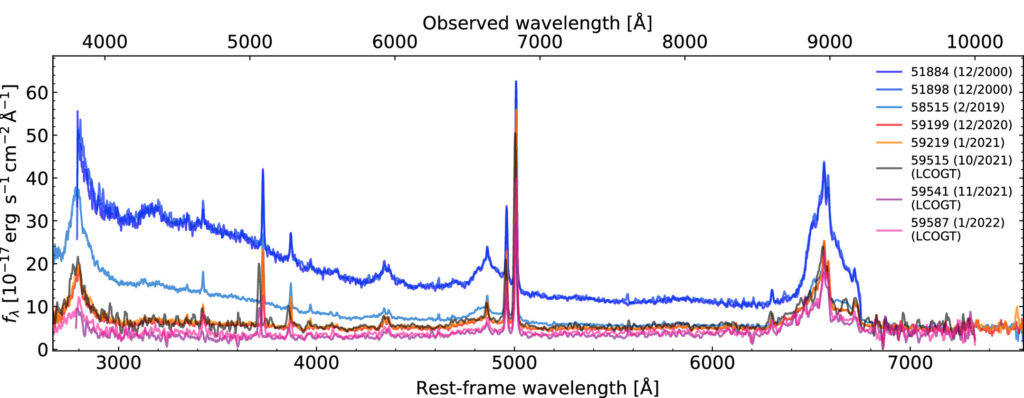
The past few decades have witnessed the success of using time-domain variability to constrain basic models of quasars, and BHM extends these adding extensive wide-area, multi-epoch optical spectroscopy to the era of time-domain imaging. In its Reverberation Mapping program, BHM will measure BH masses (the most fundamental of all BH parameters) for ~103 quasars across a broad range of luminosity and redshift, compared to the historical RM sample of ~100 primarily nearby and low-luminosity AGN. Via its AQMES (All-Quasar Multi-Epoch Spectroscopy) program, BHM will further characterize the spectral variability of ~20,000 additional quasars sampling light-travel, dynamical, and thermal timescales of days to decades, revealing broad emission line profile variations, SMBH binarity, outflow constraints, and rare quasars that shut off/on in just a few years (changing-look quasars), shedding new light on fundamental questions of SMBH accretion astrophysics.
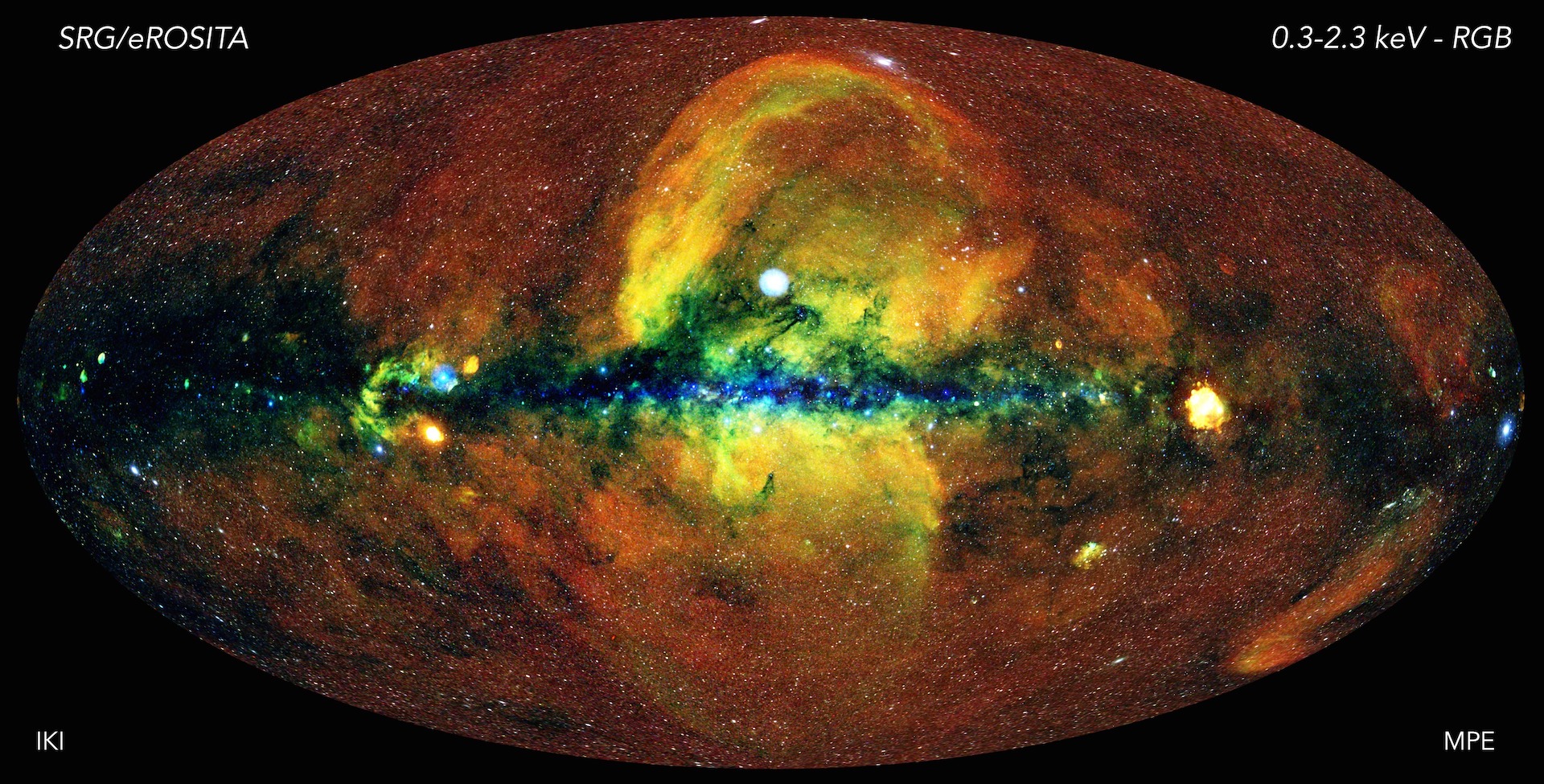
In addition, despite the high X-ray luminosity of nearly all quasars and other AGN (active galactic nuclei), we do not yet fully understand the physical origin of the tight coupling between the hot X-ray corona and the much cooler accretion disk. This is mostly due to the limited size of X-ray quasar/AGN samples compiled with past X-ray telescopes which have the necessary sensitivity (i.e. Chandra and XMM-Newton), but are limited by their relatively small fields of view (FOV). However, the successful 2019 launch of SRG/eROSITA, with both its high sensitivity and large FOV, discovered as many new X-ray sources in its first year alone as were discovered by the previous ~50 years of X-ray astronomy. Via its SPIDERS program, BHM is providing optical spectroscopic measurements (to about iAB<21.5), including identifications and redshifts, ultimately of ~300,000 eROSITA sources detected in the first 1.5 years of the all sky survey (to a 0.5-2 keV flux limit of ~2.5×10⁻¹⁴ erg/s/cm2). This eROSITA selected sample – as well as a smaller X-ray selected sample from the Chandra Source Catalog (CSC) – are comprised mainly of AGN, both unobscured and obscured; but these samples also contain X-ray emitting galaxy clusters, X-ray-bright stars (e.g., compact binaries and flaring late-type stars) in the Milky Way and nearby galaxies, extreme/rare objects, transients, and other peculiar variables found in the X-ray sky. Combining X-ray discovery and optical spectral characterization provides a major leap forward in our description of the X-ray sky, and reveals the connections between large, statistical populations of X-ray sources and the cosmic structures in which they are embedded.
What’s new in DR20?
As noted (and described) earlier on this page, the new/current public data release DR20 includes spectra (mainly BOSS optical spectra) and parameters derived therefrom for nearly 0.5 million objects/targets, which were primarily selected for spectroscopic observation by BHM, and especially dramatic expansions in optical spectroscopy from LCO in the Southern hemisphere (also where most of the BHM/SPIDERS spectroscopic targets are observed). For additional details please see further DR20 pages (and sub-pages) such as those for BHM Data, BHM Science Programs, etc. that are also listed in the menu to the right; in addition, please see supplementary, selected BHM-related Value Added Catalogs (VACs), including several related to BHM/SPIDERS.