
Astra is the glue that brings together analysis methods into a single software framework. MWM observes stars across the HR diagram with both the BOSS and APOGEE spectrographs. This wide range of stellar parameters, resolution, and wavelength coverage means that a single pipeline is not currently suitable. Links on the sidebar will take you to information about the output data products from Astra, access to Astra data files, and the pipelines in Astra.
What stars does Astra analyze?
SDSS-V targets astronomical sources of many different types (e.g., stars, galaxies) through the Mapper programs. Only stars are observed with the APOGEE instruments. The BOSS instruments usually observe active galactic nuclei for its science program, but stars are often observed with BOSS. These stars are either observed because they were assigned to a Milky Way Mapper targeting carton, an open fiber targeting carton, or because the star was observed as a calibration source for the Black Hole Mapper program.
Astra ingests a wide variety of auxiliary information for every spectrum acquired by SDSS-V. This includes survey identifiers, astrometry, photometry, targeting information, and other metadata. This data allows us to reliably identify sources that are likely stars, and are therefore of interest to Milky Way Mapper.
In general Astra is used to analyze SDSS-V APOGEE spectra, SDSS-IV APOGEE spectra from Data Release 17 (but no BOSS spectra from before SDSS-V), and any BOSS spectrum for a source assigned to specific cartons. For Data Release 20, only BOSS spectra were analyzed. So, while the below pages include information on both APOGEE and BOSS related products from Astra, only BOSS related files are updated in v_astra 0.8.1 as released in DR20. For users interested in APOGEE data, please look at v_astra 0.6.0 , which was previously released in DR19.
In Data Release 20, BOSS spectra from any carton starting with “mwm_” as well as any of the following targeting carton names were analyzed (click on “+” to expand):
Non “mwm_” BOSS Cartons processed by Astra
- bhm_csc_apogee
- bhm_csc_boss
- bhm_csc_boss-bright
- bhm_csc_boss-dark
- bhm_csc_boss_bright
- bhm_csc_boss_dark
- manual_bright_target_offsets_1
- manual_bright_target_offsets_1_g13
- manual_bright_target_offsets_3
- manual_bright_targets_g13
- manual_bright_targets_g13_offset_fixed_1
- manual_bright_targets_g13_offset_fixed_3
- manual_bright_targets_g13_offset_fixed_5
- manual_bright_targets_g13_offset_fixed_7
- manual_fps_position_stars
- manual_fps_position_stars_10
- manual_fps_position_stars_apogee_10
- manual_offset_mwmhalo_off00
- manual_offset_mwmhalo_off05
- manual_offset_mwmhalo_off10
- manual_offset_mwmhalo_off20
- manual_offset_mwmhalo_off30
- manual_offset_mwmhalo_offa
- manual_offset_mwmhalo_offb
- openfibertargets_nov2020_10
- openfibertargets_nov2020_1000
- openfibertargets_nov2020_1001a
- openfibertargets_nov2020_1001b
- openfibertargets_nov2020_12
- openfibertargets_nov2020_14
- openfibertargets_nov2020_15
- openfibertargets_nov2020_17
- openfibertargets_nov2020_19a
- openfibertargets_nov2020_19b
- openfibertargets_nov2020_19c
- openfibertargets_nov2020_22
- openfibertargets_nov2020_24
- openfibertargets_nov2020_25
- openfibertargets_nov2020_28a
- openfibertargets_nov2020_28b
- openfibertargets_nov2020_28c
- openfibertargets_nov2020_29
- openfibertargets_nov2020_3
- openfibertargets_nov2020_31
- openfibertargets_nov2020_32
- openfibertargets_nov2020_34a
- openfibertargets_nov2020_34b
- openfibertargets_nov2020_35a
- openfibertargets_nov2020_35b
- openfibertargets_nov2020_35c
- openfibertargets_nov2020_46
- openfibertargets_nov2020_47a
- openfibertargets_nov2020_47b
- openfibertargets_nov2020_47c
- openfibertargets_nov2020_47d
- openfibertargets_nov2020_47e
- openfibertargets_nov2020_5
- openfibertargets_nov2020_6a
- openfibertargets_nov2020_6b
- openfibertargets_nov2020_6c
- openfibertargets_nov2020_8
- openfibertargets_nov2020_9
- ops_apogee_stds
- ops_std_apogee
- ops_std_boss
- ops_std_boss-red
- ops_std_boss_gdr2
- ops_std_boss_lsdr8
- ops_std_boss_ps1dr2
- ops_std_boss_red
- ops_std_boss_tic
- ops_std_eboss
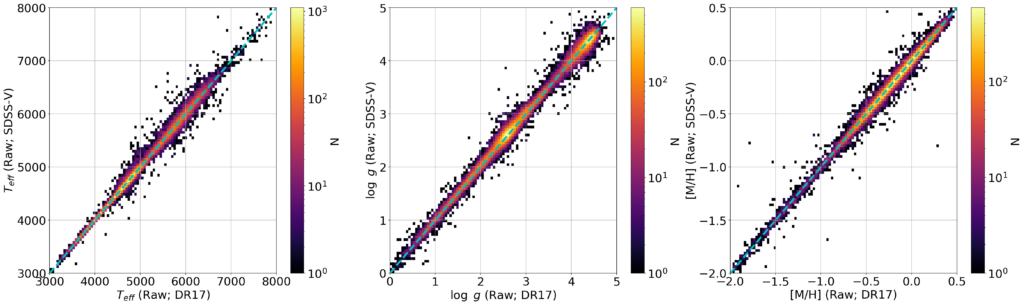
The SDSS-V APOGEE Data Reduction Pipeline for DR19 did not reduce APOGEE spectra that were taken during SDSS-IV and released as part of Data Release 17. This is a result of numerous hardware and software improvements between SDSS-IV and SDSS-V (e.g., from plates to robots; installation of the Fabry Perot Interferometer), which naturally lead to different data characteristics. The SDSS-V APOGEE Data Reduction Pipeline team prioritized the processing of SDSS-V data. Astra was therefore run on the DR17 reduced APOGEE data. Figure 1 shows the comparison of stellar parameters for stars observed in both SDSS-IV and -V and run through the same version of Astra. This demonstrates that the stellar parameters are very comparable for the APOGEE spectra of the same source, but with spectra reduced by different versions of the DRP.
What spectra does Astra use?
The APOGEE and BOSS data reduction pipelines produce many file types. Some are end products, others are intermediate products. Astra ingests only some of the file types produced by the data reduction pipelines, and those spectra are then analyzed by various pipelines.
APOGEE apVisit files
If the apVisit data arrays have 4096 pixels per chip then it was constructed from dithered exposures. If the data arrays have 2048 pixels per chip then it was not dithered. Astra parses the FITS headers of every apVisit file and creates a dithered field which indicates whether the observation was dithered or not.
These files contain reduced APOGEE (SDSS-IV and SDSS-V) exposures of an astronomical source in a single pointing. In SDSS-IV, and in early SDSS-V before we transitioned to robotic fiber positioners, a pointing would refer to a plate design. In SDSS-V a pointing refers to an allocated fiber. Note that here ‘pointing’ is a loose definition to explain the observation context: pointing is not a defined field.
An apVisit file might refer to a single exposure, or many exposures where some of them might be dithered. The apVisit spectra are bias-corrected, sky-subtracted, (vacuum) wavelength-calibrated 1D spectra in the observed frame.
APOGEE apStar files
The apStar files include co-added APOGEE spectra (SDSS-IV and SDSS-V) of a star across all nights, taken with the same telescope. For example, if a star was observed with the APOGEE instrument at Apache Point Observatory and with the APOGEE instrument at Las Campanas Observatory, then there will be two apStar files.
Astra ingests the apStar files and will analyze these spectra with various pipelines. Astra also creates its own version of the co-added APOGEE spectra as well. This is done using the apVisit files and Astra applies its own radial velocity corrections and co-adding. Astra stores these results in mwmStar files.
BOSS specFull files
The BOSS Data Reduction Pipeline only produces co-added spectra across epochs of selected sources that are relevant to Black Hole Mapper, which does not include stars.
These files include co-added BOSS spectra of an astronomical source taken on a single night.
The specFull files also include the individual reduced BOSS exposures that were used in the co-add, but those individual spectra are not considered by Astra. Only the nightly co-added BOSS spectra are considered by Astra. Here, reduced means bias-corrected, sky-subtracted, extracted 1D spectra that are wavelength-calibrated in a vacuum.
Astra produces co-adds of the BOSS specFull spectra and stores these in the mwmStar files. The mwmStar files include co-added spectra from all APOGEE and BOSS instruments from both telescopes. Spectra from a given telescope and instrument are stored in their own HDU, but those HDUs can be empty if no data has been taken.