
Overview of Stellar Abundances
In all the Astra summary files, such as astraAllStarASPCAP, the APOGEE results are in HDU2
For APOGEE spectra, the ASPCAP, AstroNN, and ThePayne pipelines produce individual abundance ratios, while the APOGEENet pipelines produces [Fe/H] only. AstroNN for DR20 was trained on ASPCAP DR17.
APOGEE Spectra Stellar Abundances
ASPCAP
Trends with Teff along the giant branch
As seen in previous data releases with APOGEE data, there are trends in abundances along the giant branch in clusters (Figure 1). Because the abundances on the giant branch should be the same for most elements, as diffusion is no longer important, these trends are not physical and can lead to, e.g., biases in abundances as a function of distance. Mészáros et al. (2025) reports equations to correct the abundances for these temperature effects. These are not included in the elemental abundances reported in the astra…ASPCAP summary files.
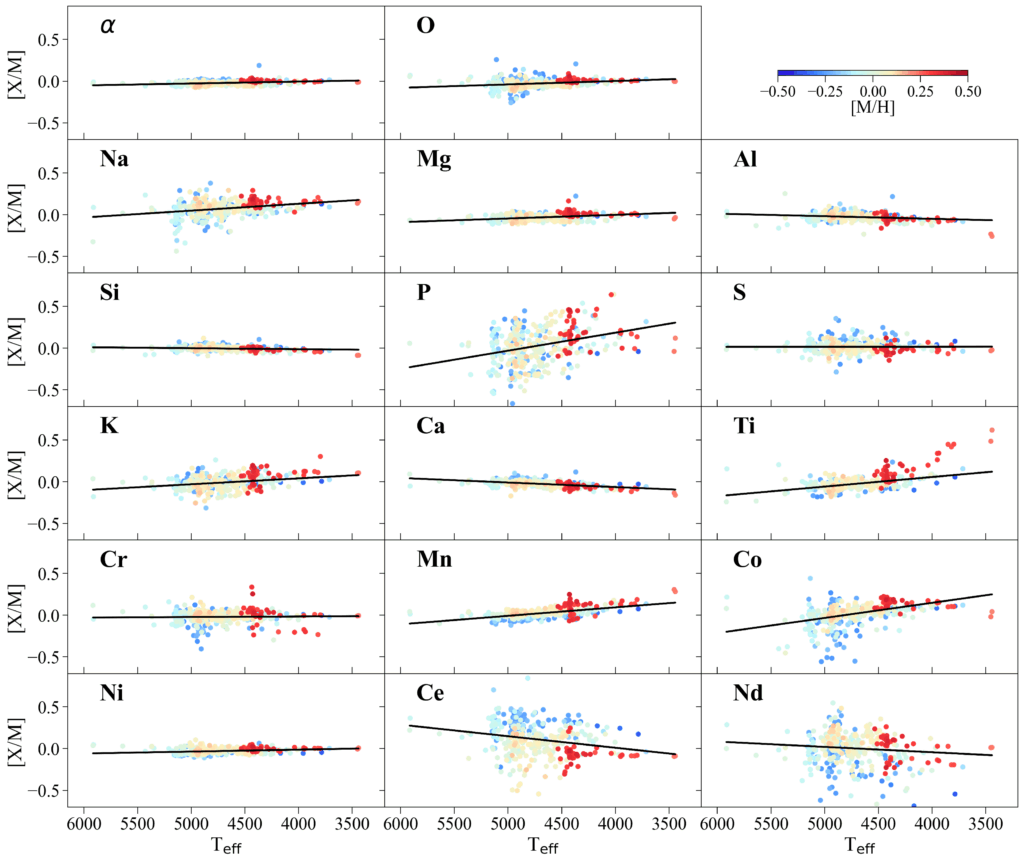
equation. Stars with S/N > 50, log g < 3.8, Teff < 6000 K, and no BAD flags were kept in the sample.
Random and Systematic Uncertainties
The uncertainties reported in the astraAllStarASPCAP file are based on repeat observations of the same star (Casey et al. in prep). Comparison with literature values shows larger uncertainties, as systematic effects are also included. See Mészáros et al. (2025) for information on the uncertainties.
Upper Limits
In DR20, there are extensive ASPCAP flags warning if one or more lines is at the 1%-5% threshold for an upper limit based on the equations from Hayes et al. (2022). These can be used to censor values that could be spurious.
Non-LTE Corrections
Thibodeaux et al. (2026) provide a value-added catalog of NLTE-corrected ASPCAP abundances for Mg, Al, Si, Ca, Ti, Mn, and Ni for DR20 ASPCAP results.
AstroNN and The Payne
We are currently working on comparisons of ASPCAP and AstroNN and The Payne pipelines. More information soon.
BOSS Stellar Abundances
Currently, the only abundance ratio available for BOSS spectra is [α/Fe] for a subset of stars. For FGK stars, the value added catalog BOSS-CLAM has reasonable estimates for [alpha/Fe]. For the Halo and Magellanic Genesis cartons, we recommend using the MINESweeper value added catalog that provides accurate [Fe/H] and [alpha/Fe] (where alpha is primarily Mg). For M dwarfs, [α/Fe] is reported by the SLAM. For OBA stars, we do not report any abundance ratios beyond [Fe/H].