
The first of four short films invites viewers to discover the powerful telescopes and groundbreaking science behind the search to map the entire night sky.
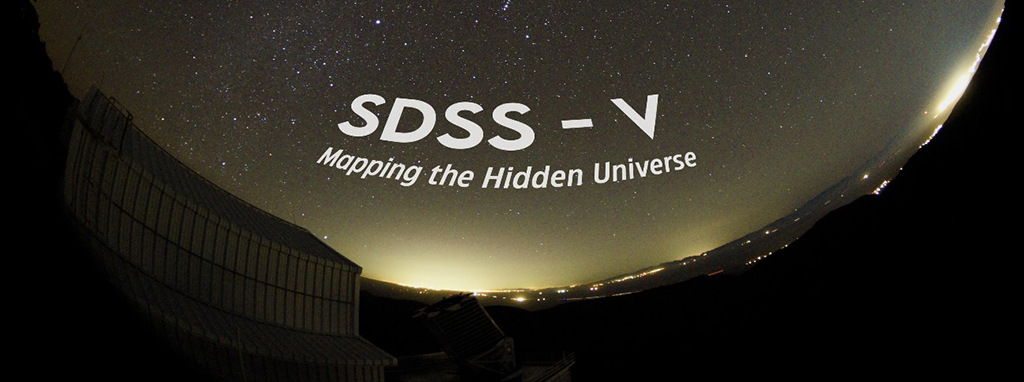
Image credit: Fiske Planetarium and the SDSS-V collaboration
Fiske Planetarium at the University of Colorado Boulder, in collaboration with the Sloan Digital Sky Survey (SDSS-V), has released Mapping the Hidden Universe. This new 10-minute fulldome film introduces audiences to the cutting-edge technology and cosmic exploration driving one of the most ambitious astronomical surveys ever undertaken.
SDSS-V is an international collaboration of astronomers using telescopes in both the Northern and Southern hemispheres to create the most detailed 3D map of the cosmos ever made. The initiative focuses on three key scientific quests: mapping the history and structure of stars in our Milky Way, tracking the growth of supermassive black holes in distant galaxies, and investigating the giant clouds of gas where stars are born and die. Together, these projects are analyzing the light from tens of millions of stars and galaxies.
Mapping the Hidden Universe takes viewers from Apache Point Observatory in New Mexico to Las Campanas Observatory in Chile to reveal how telescopes capture starlight each night. The film shows how breaking light down into its component rainbow of color wavelengths allows astronomers to unlock cosmic secrets, measure distances to stars, and uncover what distant objects are made of.
“Planetaria across the world bring millions of people to their domes to bring knowledge to visitors of all ages in a beloved format” said Dr. Juna Kollmeier, the Director of SDSS-V. She continued “we wanted to share our project with those visitors — some of whom will go home and dig deeper into their curiosity.”
Contacts
Emily Griffith
Scientific Spokesperson, SDSS-V
University of Colorado Boulder
Emily.Griffith-1@colorado.edu
Juna Kollmeier
Director, SDSS-V
Carnegie Science
jak@carnegiescience.edu
The film’s debut coincides with SDSS’s latest public data release (DR20) earlier this month, adding millions of newly analyzed starlight signatures to one of the world’s largest astronomical databases. SDSS has long been committed to making its findings freely available to researchers and the public worldwide. Mapping the Hidden Universe extends that mission by bringing the thrill of cosmic discovery directly into planetarium domes.
“Mapping the Hidden Universe is another way of introducing countless planetaria visitors to the ground-breaking science and mission of SDSS to chart millions of stars, galaxies, and black holes, and this compelling visualization follows in the collaboration’s long tradition of making knowledge about the cosmos broadly accessible to all,” said Evan Michelson, director of the Alfred P. Sloan Foundation’s SDSS program.
Mapping the Hidden Universe is available to view or download for free. A rectangular version of the film can be viewed on SDSS-V’s website here, and the fulldome planetarium film is available for download through Fiske Planetarium here.
This release is the first in a four-part series co-produced by Fiske Planetarium and SDSS-V. The remaining three short films, each focusing on a specific part of the survey’s mission, will arrive later this year.
“SDSS has pushed the boundaries of what we know about the universe for decades while being committed to sharing this new knowledge with the world,” said Dr. Emily Griffith, spokesperson for SDSS-V. “We’re thrilled to continue this work and bring SDSS-V to planetarium audiences everywhere.”
About the SDSS
Funding for the Sloan Digital Sky Survey V has been provided by the Alfred P. Sloan Foundation, the Heising-Simons Foundation, the National Science Foundation, and the Participating Institutions. SDSS acknowledges support and resources from the Center for High-Performance Computing at the University of Utah. SDSS telescopes are located at Apache Point Observatory, funded by the Astrophysical Research Consortium and operated by New Mexico State University, and at Las Campanas Observatory, operated by the Carnegie Institution for Science. The SDSS web site is www.sdss.org.
SDSS is managed by the Astrophysical Research Consortium for the Participating Institutions of the SDSS Collaboration, including Caltech, the Carnegie Institution for Science, Chilean National Time Allocation Committee (CNTAC) ratified researchers, The Flatiron Institute, the Gotham Participation Group, Harvard University, Heidelberg University, The Johns Hopkins University, L’Ecole polytechnique fédérale de Lausanne (EPFL), Leibniz-Institut für Astrophysik Potsdam (AIP), Max-Planck-Institut für Astronomie (MPIA Heidelberg), Max-Planck-Institut für Extraterrestrische Physik (MPE), Nanjing University, National Astronomical Observatories of China (NAOC), New Mexico State University, The Ohio State University, Pennsylvania State University, Smithsonian Astrophysical Observatory, Space Telescope Science Institute (STScI), the Stellar Astrophysics Participation Group, Universidad Nacional Autónoma de México, University of Arizona, University of Colorado Boulder, University of Illinois at Urbana-Champaign, University of Toronto, University of Utah, University of Virginia, Yale University, and Yunnan University.