
The Motivation and Driving Questions:
The Hidden Galaxy Explorer (HGE) aims to reveal and characterize the “hidden half” of the Milky Way: regions on the far side of the bulge and bar and deep within the Galactic midplane that remain poorly explored due to dust extinction and stellar crowding. Using dual-hemisphere, high-resolution near-infrared spectroscopy, HGE addresses several fundamental questions:
- How symmetric is the Milky Way disk and spiral structure when the obscured far side is mapped at the same fidelity as the near side?
- What are the three-dimensional structure, chemistry, and dynamics of the far-side bar and inner bulge, including spherical and X-shaped components?
- Are there measurable kinematic or chemical asymmetries in the inner disk and bulge that reflect recent or ongoing interactions (e.g., with the Sagittarius dwarf or the Magellanic Clouds)?
- Can we measure the full 360-degree Galactic rotation curve and identify non-axisymmetric perturbations such as bar-driven streaming motions or interaction-induced corrugations?
- Are there significant stellar substructures, clusters, or satellite remnants preferentially hidden behind the bulge and midplane?
Science Goals, Deliverables and Uniqueness:
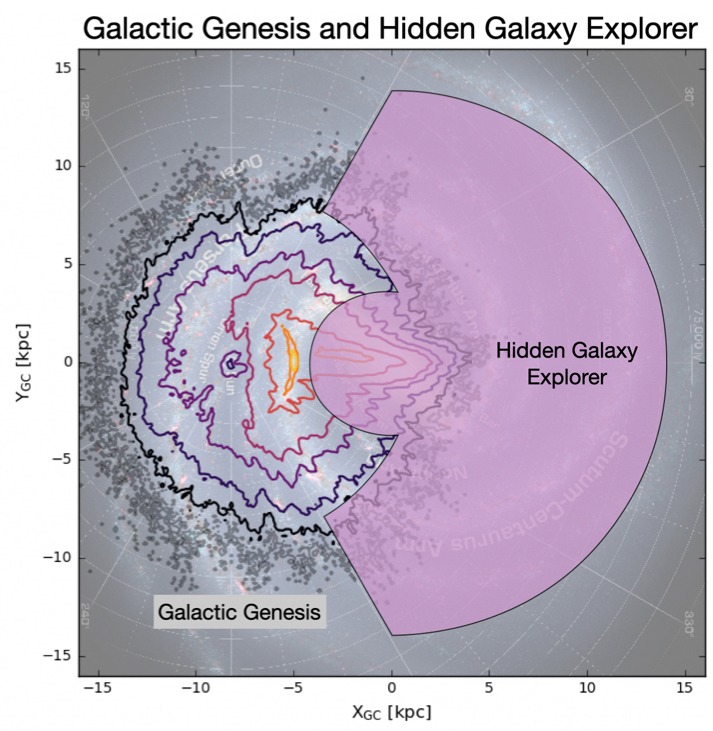
HGE is designed to provide the first comprehensive chemo-dynamical map of the Milky Way’s far disk, bulge and bar. It exploits the unique capabilities of the dual-hemisphere SDSS/APOGEE spectrographs to observe dust-obscured regions inaccessible to optical surveys. Key elements that distinguish HGE from all other current or planned surveys:
- Dual-hemisphere coverage combined with wide-area, high-resolution near-infrared spectroscopy, enabling contiguous mapping of the inner and far side of the Galaxy.
- Depth and sensitivity optimized for the far disk and midplane, reaching faint luminous giants (H ≈ 14.5) with long integrations and multi-visit cohort strategies.
- Étendue and survey efficiency unmatched by other facilities targeting similar science.
- Strong synergy with NASA’s Roman Galactic Plane Survey and asteroseismic targets.
By filling the most critical spatial gap in our current Galactic maps, HGE transforms our view of the Milky Way from a near-side-biased picture into a truly global one.
HGE will deliver a lasting legacy dataset for Galactic astronomy, including:
A contiguous Milky Way chemo-dynamical map spanning the far disk, bulge and bar, enabling definitive tests of Galactic symmetry, bar structure, and inner-disk dynamics.
- A million star sample observed at high spectral resolution in the most heavily obscured regions of the Galaxy.
- Spectroscopic products that directly support Roman bulge and Galactic plane programs.
- Fully reduced spectra and homogeneously derived stellar parameters and abundances.
Together, these deliverables will enable transformative advances in our understanding of the Milky Way’s structure, formation history, and dynamical evolution.
Contact information
For more information on the Hidden Galaxy Explorer, contact the AS5/HGE Program Head: David Nidever (Montana State University)
To sign up for the HGE mailing list please do so here.