
The Dynamic Universe Explorer (DUE) will deliver spectroscopic follow-up of interesting events and variable sources as well as high-cadence monitoring of a range of variable sources. DUE will observe these phenomena with the BOSS and APOGEE spectrographs, which respectively operate in optical and near-IR. This program has three distinct components/subsurveys and is designed to complement ongoing photometric surveys by building a transformative spectroscopic dataset.
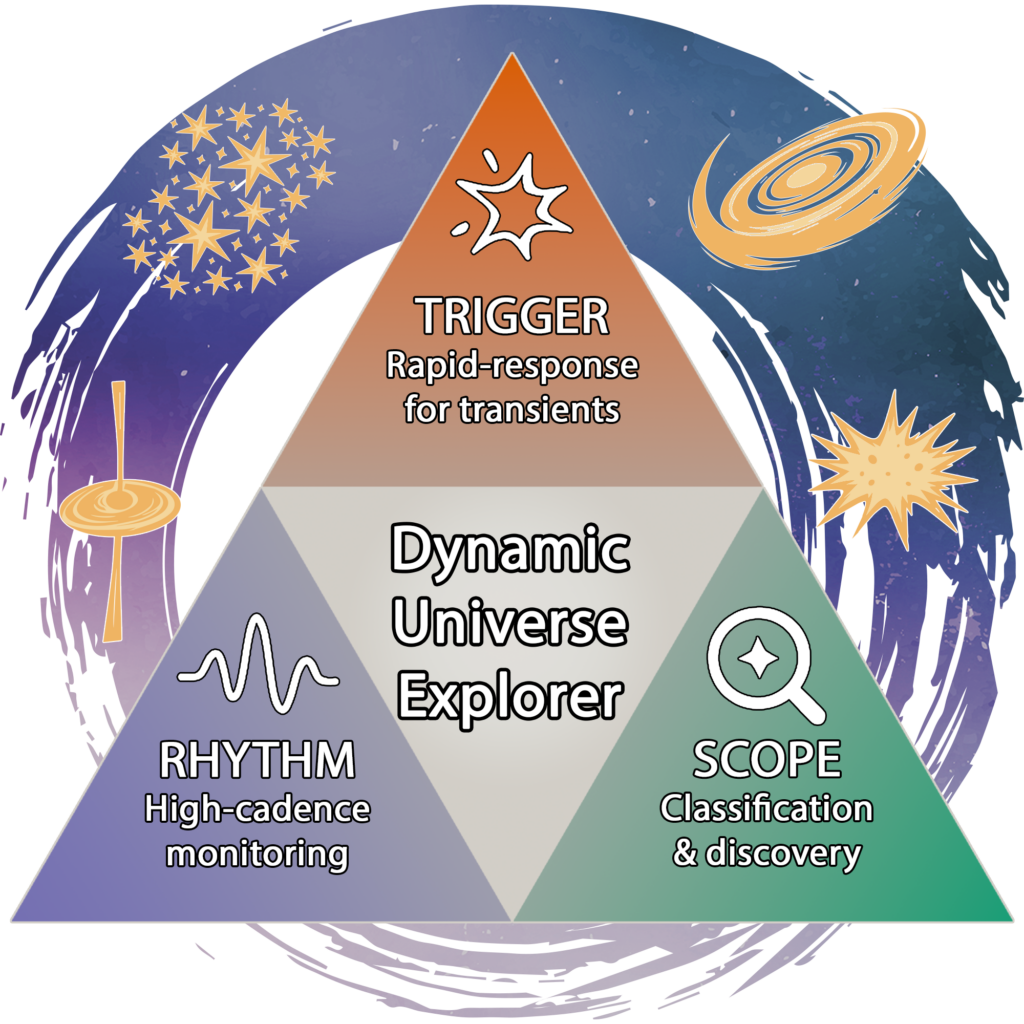
TRIGGER (Transient Rapid-response Investigation of Galactic and extraGalactic Events):
DUE will carry out rapid-response spectroscopy of short-lived phenomena such as supernovae, cataclysmic variables, tidal disruption events, and others. By dynamically allocating telescope time, the program anticipates obtaining 1,000+ transient spectra, offering collaboration members the flexibility to prioritize targets of greatest scientific interest. This effort will establish a large, homogeneous spectroscopic dataset for transient classification and physical interpretation, significantly enhancing our understanding of dynamic processes in both galactic and extragalactic environments.
RHYTHM (Repeated High-Cadence Yield for Temporal Horizon Monitoring):
DUE will conduct weekly spectroscopic observations of select fields for 3–5 years.
Inside the Milky Way, DUE will deliver spectroscopic light curves tracking changes in radial velocities, emission and absorption line profiles, chemical abundances, and other fundamental properties of stars. It will support investigations such as rotational modulation and disk occultation in young stellar objects, astroseismology, multiplicity, and more.
Outside our galaxy, DUE will monitor hundreds of active galactic nuclei (AGN) to constrain black hole masses using reverberation mapping, map the structure of the broad-line region, and examine the variability of AGN on long (>10-year) and short (~weekly) timescales.
SCOPE (Single-epoch Classification of Photometric Events):
DUE will obtain single-epoch spectra for large samples of variable sources across the sky to classify and further investigate interesting objects. This program will target variable stars, compact binaries, changing-look active galactic nuclei, and other SMBH accretion events, among others. By building a comprehensive spectroscopic catalog, this effort will improve population statistics, refine variability taxonomies, and enable the discovery of rare or previously unrecognized classes of variable phen
Contact information
For more information on the Dynamic Universe Explorer, contact the AS5/DUE Program Heads: Kate Grier (University of Wisconsin) and Marina Kounkel (University of North Florida)
To sign up for the DUE mailing list please do so here.