
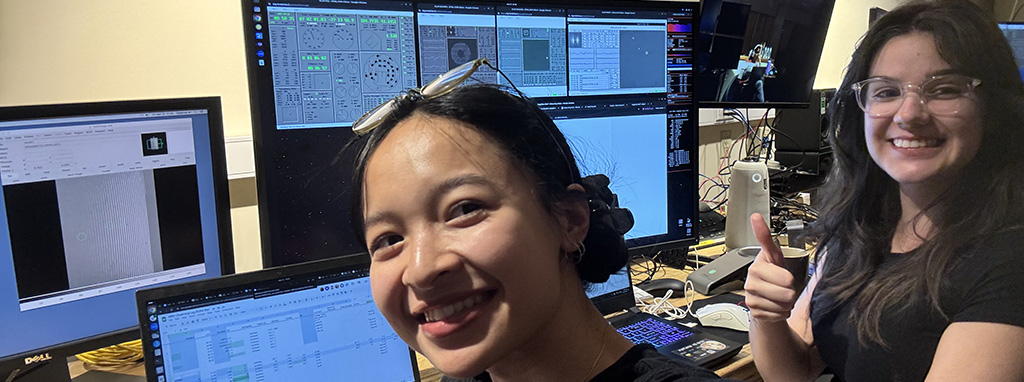
A class of undergraduate students at University of Chicago has used data from the Sloan Digital Sky Survey (SDSS) to discover one of the oldest stars in the universe, a star that formed in a companion galaxy and migrated to the Milky Way.
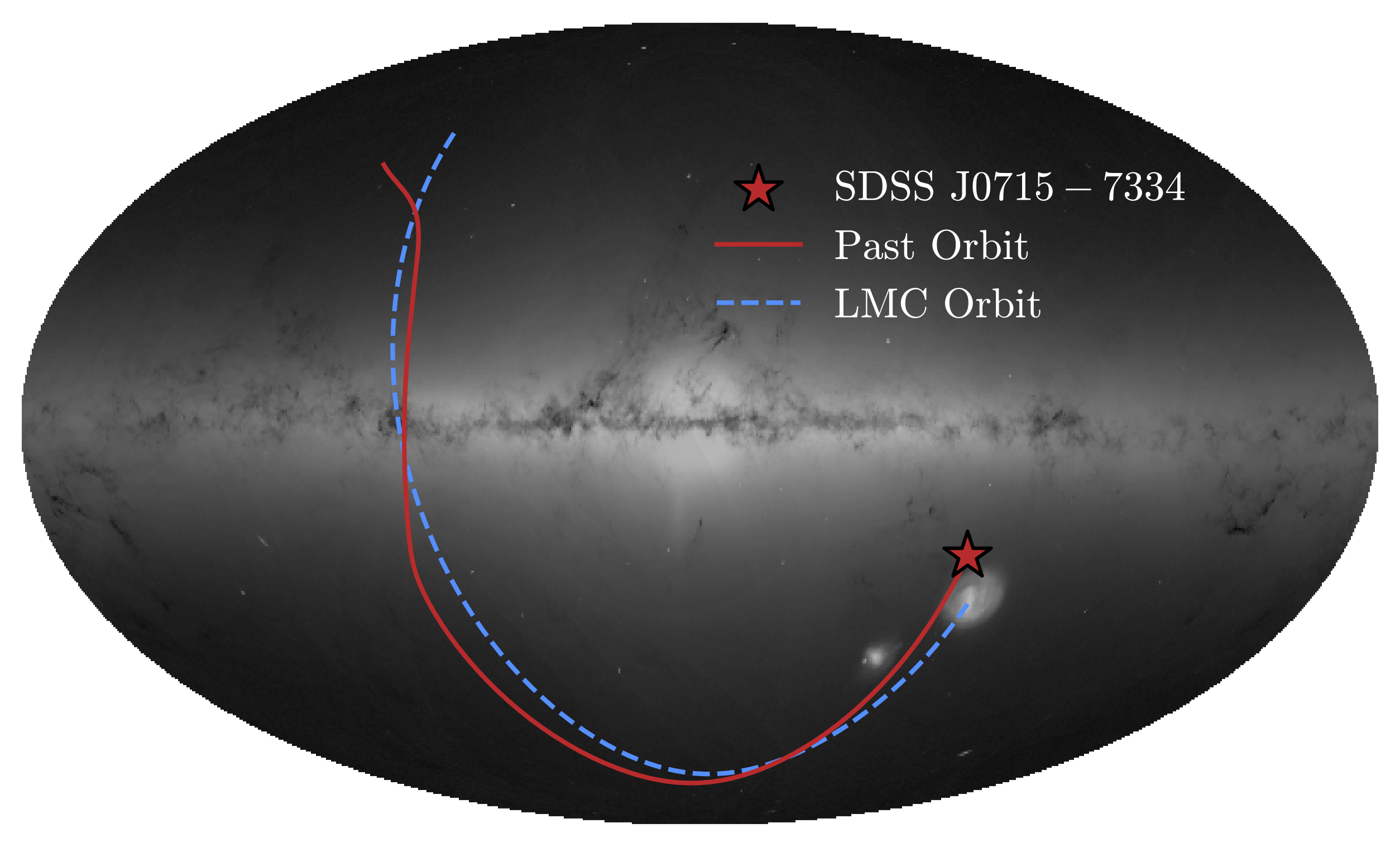
Click for a larger version
Image Credit: Vedant Chandra and the SDSS collaboration
Background ESA/Gaia image, A. Moitinho, A. F. Silva, M. Barros, C. Barata, University of Lisbon; H. Savietto, Fork Research, under a Creative Commons license CC BY‐SA 3.0 IGO.
The ten students found the star as part of their “Field Course in Astrophysics” course at the University of Chicago, led by Professor Alex Ji, the deputy Project Scientist for SDSS-V, and graduate teaching assistants Hillary Andales and Pierre Thibodeaux.
SDSS, an international collaboration of over 75 scientific institutions across the globe, has been operating for 25 years with a commitment to make data from its survey publicly available and broadly usable to all. In its latest phase, it uses robots to rapidly acquire spectra of millions of objects across the sky with the aim of improving our understanding of how stars, black holes and galaxies grow and evolve over cosmic time.
In Professor Ji’s class, SDSS is embedded into the curriculum. The students spent the first several weeks looking through data from the newest phase of the SDSS, searching for interesting stars. After examining several thousand, they made a list of 77 to further observe on a field trip to Las Campanas Observatory.
They then spent their Spring Break at Carnegie Science’s Las Campanas Observatory in Chile, using the Magellan Inamori Kyocera Echelle (MIKE) instrument on the Magellan telescopes. The night of March 21st, 2025 was their first night on the telescope. The second star they observed, named SDSSJ0715-7334, turned out to be the one that justified the trip.
“We found it the first night, and it completely changed our plans for the course,” Ji said.
The plan was to observe each star for 10 minutes, but the second night the students observed it for three hours. “I was looking at that camera the whole night to make sure it was working,” said Natalie Orrantia, one of the students who made the discovery.
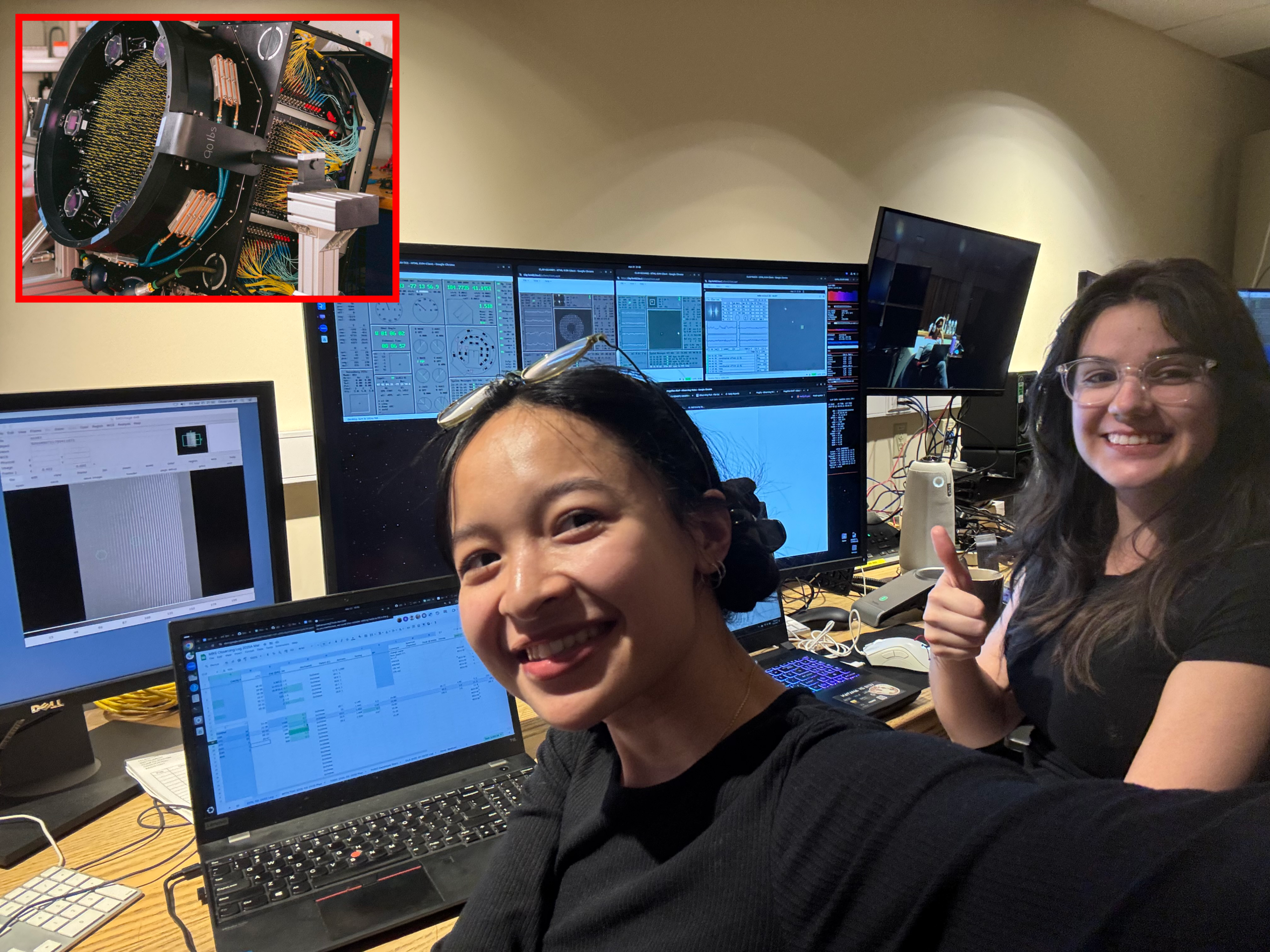
Inset: The Irenee duPont telescope is the site of SDSS-V’s Southern sky component, which is rapidly surveying the cosmos. This telescope was reinvigorated with a new instrument suite and a new robotic focal plane to enable SDSS-V (left hand photo).
Click for a larger version.
Image Credit: Main image: Ha Do (University of Chicago); Inset: SDSS Collaboration
The star turned out to be the most pristine ever found, composed almost completely of hydrogen and helium. This composition suggests it is one of the oldest stars ever seen. Analysis of its orbit shows it formed in the Large Magellanic Cloud and migrated into the Milky Way billions of years ago. These two facts led Alex Ji, the students’ Professor at University of Chicago, to call the star an “ancient immigrant.”
“This ancient immigrant gives us an unprecedented look at conditions in the early universe,” said Ji. “Big data projects like SDSS make it possible for students to get directly involved in these important discoveries.”
Contacts
Alex Ji
University of Chicago
alexji@uchicago.edu
Natalie Orrantia
University of Chicago
orrantianm@uchicago.edu
Ha Do
University of Chicago
hado@uchicago.edu
Juna Kollmeier
Director, Sloan Digital Sky Survey V
Carnegie Science
jak@carnegiescience.edu
Astronomers refer to any elements heavier than hydrogen and helium as “metals,” and the amount of those elements present in a star is known as its “metallicity.” With only 0.005 percent of the metals found in our Sun, SDSSJ0715-7334 has the lowest metallicity of any star yet observed in the Universe – more than twice as metal-poor as the previous record holder.
“We analyzed the star for a large swath of elements, and the abundances are quite low for all of them,” said Ha Do, another of the students who discovered the star.
What does it mean for a star to have low metallicity? Because elements heavier than hydrogen and helium can only be produced in supernova explosions, stars with few of these elements must have formed from gas before most of the supernovae in the Universe ever occurred. In other words, the star must be ancient, from the first few generations of stars that ever formed.
The team also used data from the European Space Agency’s Gaia mission to find the distance to the star and its motion through our galaxy. By tracing its motion back through the billions of years the star has existed, the team identified the birthplace of the star: in the Milky Way’s largest companion galaxy, the Large Magellanic Cloud.
The Ancient Immigrant contained further surprises for the students who discovered it. Ji divided the class into groups, each focusing on a different type of analysis of the star. Orrantia and Do led the team that studied the carbon content of the star, which turned out to be so low that it was undetectable.
“The star has so little carbon that it suggests an early sprinkling of cosmic dust is responsible for making it,” said Ji. “This formation pathway has only been seen once before.”
Contributing to such a discovery so early in their careers has helped Orrantia and Do decide to continue to pursue graduate careers in astronomy.
“To be able to actually contribute to something like this, it’s very exciting,” Do said.
“These students have discovered more than just the most pristine star.” said Juna Kollmeier, the Director of SDSS-V. “They have discovered their inalienable right to physics. Surveys like SDSS and Gaia make that possible for students of all ages everywhere on Earth and this example shows that there is still plenty of room for discovery.”
About the SDSS
Funding for the Sloan Digital Sky Survey V has been provided by the Alfred P. Sloan Foundation, the Heising-Simons Foundation, the National Science Foundation, and the Participating Institutions. SDSS acknowledges support and resources from the Center for High-Performance Computing at the University of Utah. SDSS telescopes are located at Apache Point Observatory, funded by the Astrophysical Research Consortium and operated by New Mexico State University, and at Las Campanas Observatory, operated by the Carnegie Institution for Science. The SDSS web site is www.sdss.org.
SDSS is managed by the Astrophysical Research Consortium for the Participating Institutions of the SDSS Collaboration, including Caltech, the Carnegie Institution for Science, Chilean National Time Allocation Committee (CNTAC) ratified researchers, The Flatiron Institute, the Gotham Participation Group, Harvard University, Heidelberg University, The Johns Hopkins University, L’Ecole polytechnique fédérale de Lausanne (EPFL), Leibniz-Institut für Astrophysik Potsdam (AIP), Max-Planck-Institut für Astronomie (MPIA Heidelberg), Max-Planck-Institut für Extraterrestrische Physik (MPE), Nanjing University, National Astronomical Observatories of China (NAOC), New Mexico State University, The Ohio State University, Pennsylvania State University, Smithsonian Astrophysical Observatory, Space Telescope Science Institute (STScI), the Stellar Astrophysics Participation Group, Universidad Nacional Autónoma de México, University of Arizona, University of Colorado Boulder, University of Illinois at Urbana-Champaign, University of Toronto, University of Utah, University of Virginia, Yale University, and Yunnan University.